




The real world is messy.
Finance and Accounting teams simplify the messiness of business into reports, then use those reports to drive Operations decisions.
But, to borrow a metaphor, the report is not the territory. Reports summarize, which is valuable - but as Operators know, the devil is in the details.
How can a single product provide Operators complete flexibility to adapt to their messy, rapidly-changing businesses, while giving Finance teams a reliable and configurable reporting platform?
By making the real world the product itself.
Reality as the center of the product
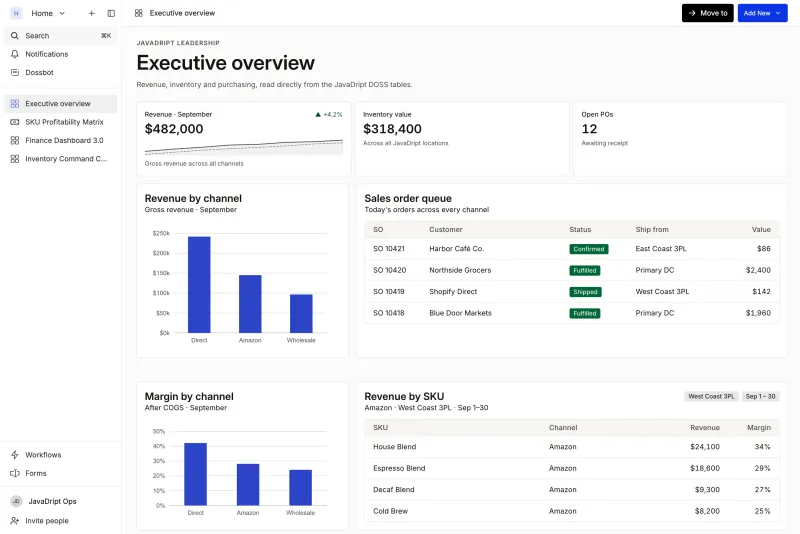
The DOSS World Model is a unified representation of physical goods operations, from purchasing and manufacturing through order management and fulfillment, where real-world movements generate synchronous financial reporting telemetry.
Each event recorded or action taken on the DOSS platform is real-time renderable as its financial impacts. This includes custom-configured actions responding to live changes in your reporting policies, down to how individual SKUs within individual transactions are handled, if only once.
We built this system as the core of the new Product Suite because we believed that neither Operators nor Finance users were served effectively by existing solutions.
Reporting-first solutions like ERPs and General Ledgers struggle to represent complexity, leading Operators to handle messiness “off the books” and then input it later. This is because reports are, by definition, non-atomic and opinionated. Even a Journal Entry for a single item is an after-the-fact compression of rich, cross-functional information. An aggregate can never be an atom, and only atoms could enable the composability we were looking for.
That said, composable point solutions like Order and Inventory Management software often strayed too far. The promise of agility where it’s needed most is a double-edged sword: reporting flows that executives and outside stakeholders depend on could be broken beyond repair by a well-intentioned “fix,” leaving Finance stuck cleaning up. We even saw this in DOSS, when an accidental edit on the production floor caused an invoicing flow to break days later.
Any tool that creates more work is not a useful tool — so, we went back to first principles.
Outgrowing the abacus
Luca Pacioli’s Summa de arithmetica (1494) is credited with inventing accounting.
But it could just as easily be credited with event-driven architecture.
In 15th century Florence, computing was done by hand on an abacus, leaving little room for floating points (unless it was thrown out a window). Despite arithmetic taking minutes, the idea of an event log materializing into point-in-time reporting proved to be robust and scalable. Everything from messaging queues to Jay Kreps’ famous observation that “everything is a log” has intellectual roots in Pacioli.
Funny enough, accounting software does not.
Even modern log-like ERP systems such as S4HANA stop short of a true event-driven architecture. At the boundary, they mistake outputs (journal entries) for inputs (real-world events with both operational and financial impacts). Their fundamental unit is a lossy representation of real events, and therefore not fundamental: forgivable on an abacus, but unnecessary today.
With this in mind, we set out to rebuild the core of the DOSS product around the interaction of real-world atoms, instead of their projections. This single insight unlocked the DOSS World Model.
The Unified Substrate
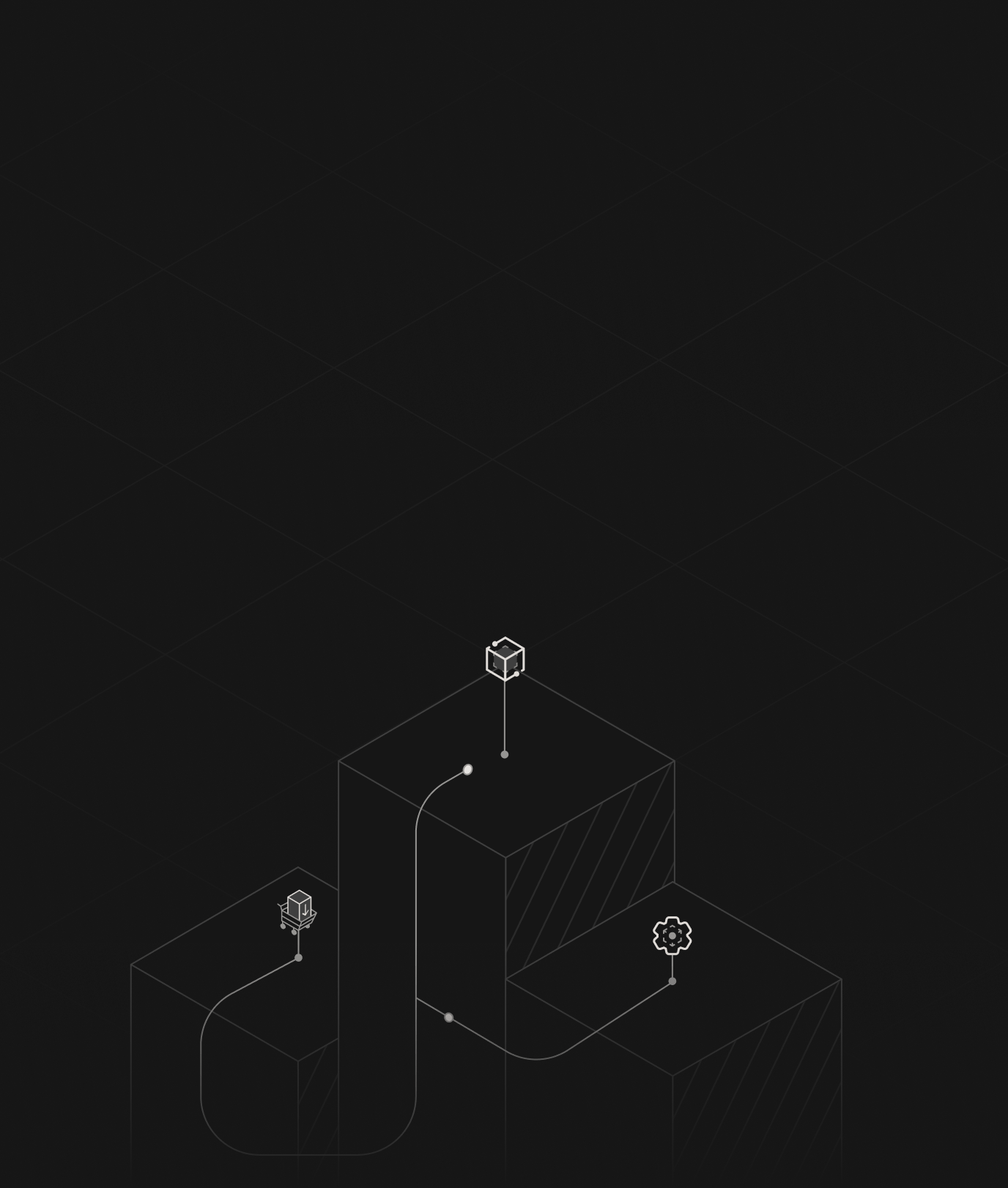
The fundamental component of the DOSS World Model is a log-like platform that we call the Unified Substrate.
Applications like Order Management both read from and write to the substrate through type-safe surfaces, enabling confident and arbitrary composability of Operations logic with verifiable Financial results.
A written action involving Items has an accompanying co-movement of Values that is not derived after-the-fact but is instead synchronous. These movements are recorded in a single, immutable Transactions Log.
Finance & Accounting reads from the same substrate, with materialized reporting realized through configurable Rules and Policies. Because we are recording the atomic truths of business operations, every piece of transactional metadata is a potential Dimension.
The result is complex and adaptive Operations, with consistent and configurable Financial reporting. If the world around your business changes, the DOSS World Model adapts. Just like in the real world. And unlike in any other software.
What’s next
Complex supply chains, volatile costs, and a diverse ecosystem of partners and channels make up the modern enterprise. And yet, Accounting, Operations, and Finance teams are stuck with digital versions of medieval tools just because no one stopped to ask why.
We built the DOSS World Model because we believe that real world businesses deserve better.
If you’re interested in learning more (or helping build it!), please reach out.