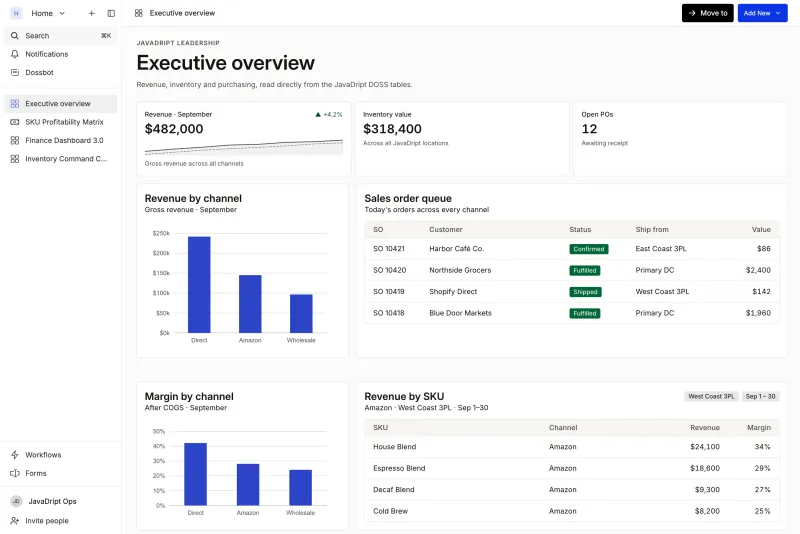





Every operations team starts on spreadsheets. Spreadsheets make sense at the start. They're free, flexible, and fast to set up, which is exactly what a scrappy ops team needs early on. But as teams grow, the same tool that got them off the ground starts to show its limits.
Spreadsheets weren't built for real-time collaboration, version control, or the complexity that comes with scale, and the gaps they leave behind are where mistakes get made. DOSS surveyed 1,003 U.S. operations professionals working across spreadsheet-heavy workflows to find out what staying on spreadsheets is costing them.
Key Takeaways
- 22% of operations professionals deal with spreadsheet errors every single day.
- On average, professionals spend 3.6 hours per week fixing spreadsheet mistakes. That adds up to more than 22 full workdays per year, per employee.
- A single significant spreadsheet error costs organizations an average of $4,315, and for 53% of teams, errors are a weekly occurrence.
- 2 in 5 spreadsheet incidents are fixed without ever being reported to leadership.
- Only 41% of organizations have a formal quality-control process for spreadsheets used in high-stakes decisions, yet 60% admit they are too dependent on them.
- 1 in 5 organizations has had a spreadsheet error expose or compromise confidential data.
Errors by the Numbers
Most spreadsheet errors come down to the same handful of mistakes. And the damage they do in time, money, and data exposure is costly.
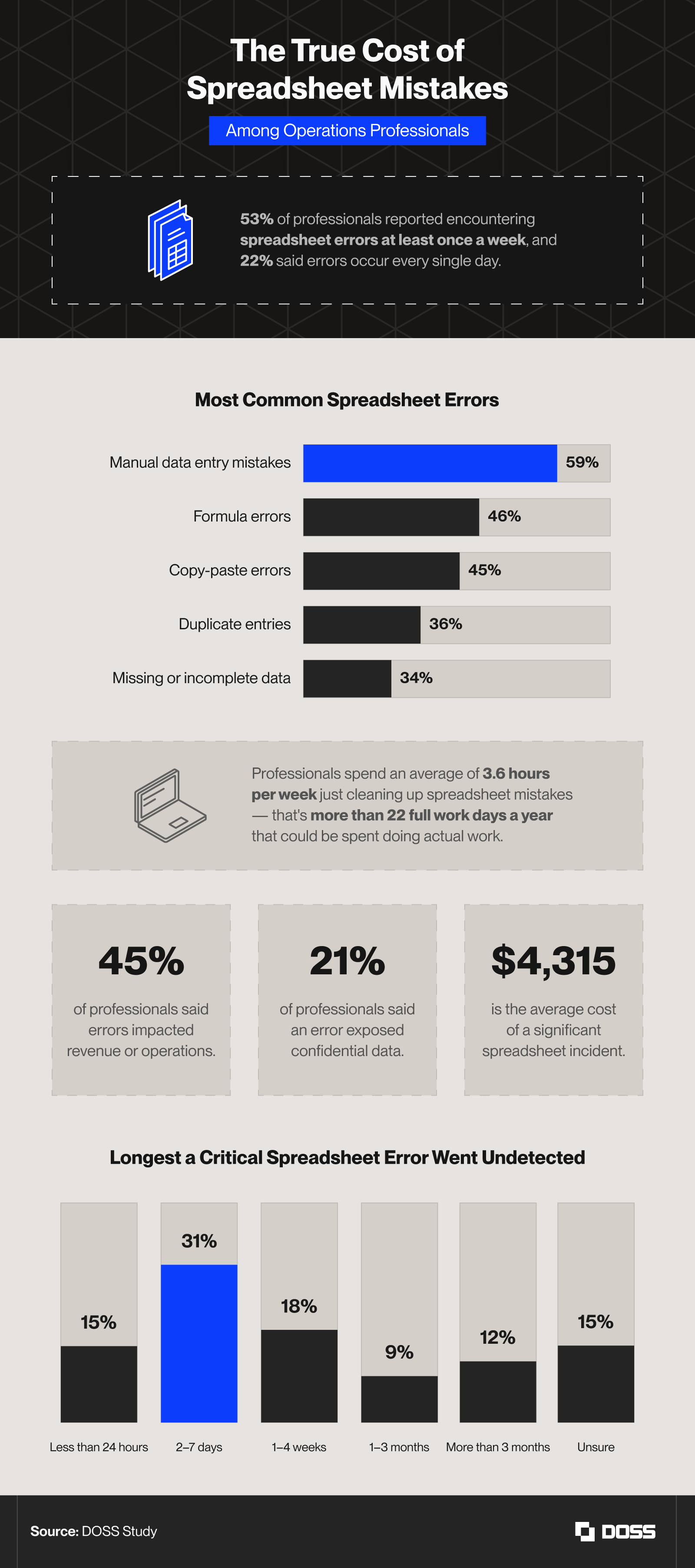
More than half of operations professionals (53%) deal with spreadsheet errors every week, and 22% face them daily. The most common are manual data entry mistakes (59%), formula errors (46%), and copy-paste issues (45%).
Teams spend an average of 3.6 hours per week fixing those mistakes, which adds up to more than 22 full workdays per year per employee. That's time pulled away from planning, forecasting, and supplier management, and that’s before the financial cost.
A single significant error costs organizations an average of $4,315. In practice, that number shows up as missed orders, expedited freight, or lost revenue during peak demand.
Here's how some of those incidents played out, in respondents' own words:
"We had a broken VLOOKUP in our master procurement sheet that failed to pull updated lead times for a key raw material. This caused us to under-order during a peak period. We realized the error when production stopped, forcing us to pay for expedited air freight and overtime for the warehouse crew to catch up."
– Survey respondent, Manufacturing
"My company recently enacted layoffs of specific teams the client no longer wanted to utilize. The main roster spreadsheet was automatically updated by team rosters, but one link wasn't updating properly. Several team members who should have been included in the layoffs were not, and one team member who was necessary for a priority project was unintentionally let go and had to be brought back on weeks after he was accidentally laid off.
– Survey respondent, Information technology
"Due to errors in manual entry, we placed an incorrect order from a supplier that affected our stock and resulted in less inventory than necessary. During a rush time of year, we lost significant business due to canceling orders and not having the product available."
– Survey respondent, Retail
"A spreadsheet containing salary information was published online as a source document. It should have been converted to a single document first. It was caught within 8 hours and remedied, but the exposure had already occurred."
– Survey respondent, Manufacturing
"We use spreadsheets to compare our reimbursements from different insurance carriers. A spreadsheet error occurred when the Medicaid reimbursements were mixed up with the Medicare reimbursements. We thought Medicare was underpaying us due to the error."
– Survey respondent, Health care
When Errors Go Unreported
The errors are bad enough. What happens after them is worse.
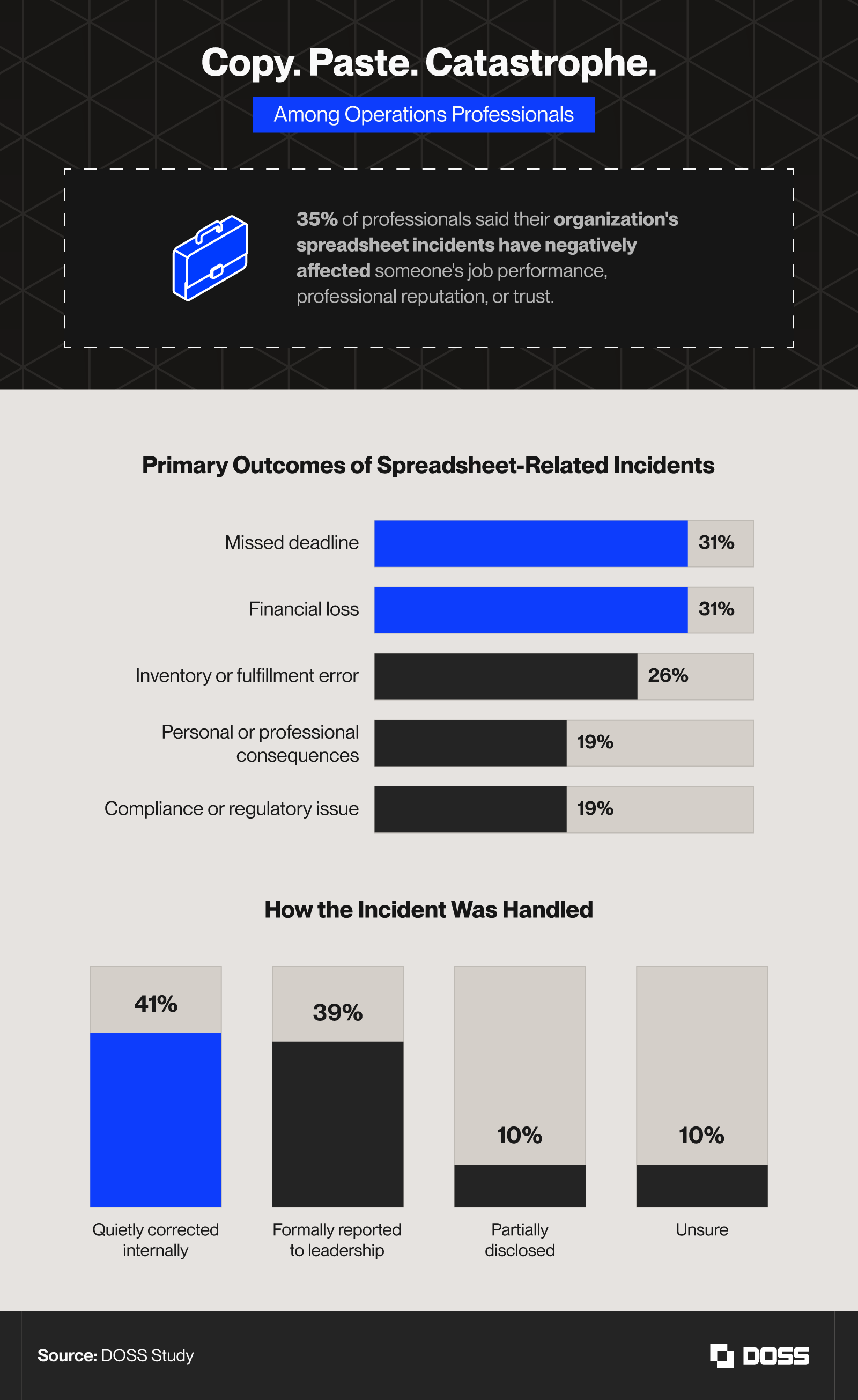
About two in five spreadsheet incidents are fixed without ever being reported to leadership. That means the people making strategic decisions are working with an incomplete picture of how reliable their data actually is.
The stakes behind those unreported incidents are high. One in five organizations experienced a spreadsheet error that exposed or compromised confidential data. And in 35% of incidents, someone's job performance, reputation, or trust took a hit.
Overdependent and Underprepared
Knowing something is a problem and fixing it are two different things.
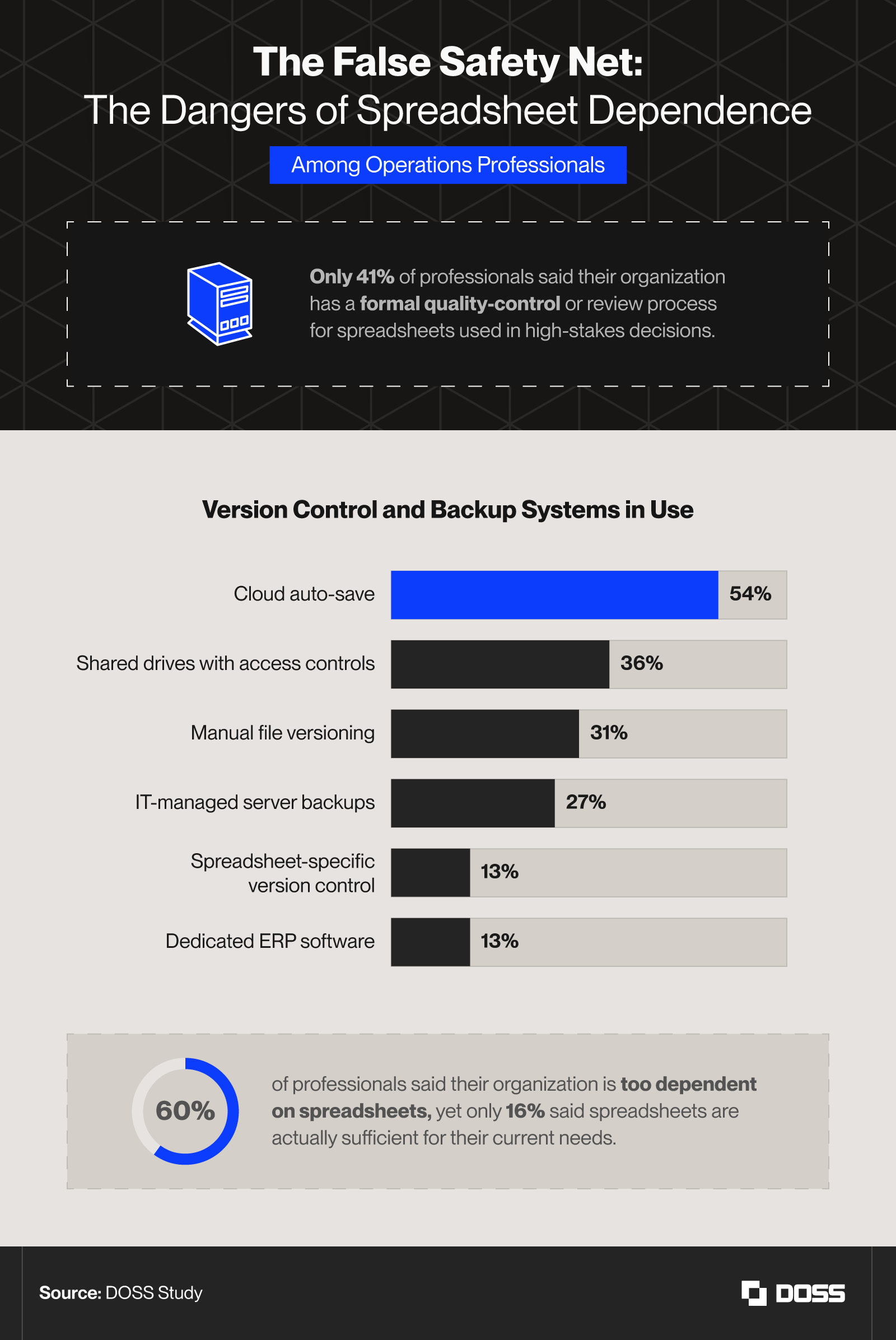
Even though 60% of teams depend on spreadsheets, only 41% have a formal quality-control process in high-stakes decisions. That leaves the majority relying on manual checks, ad hoc reviews, or nothing at all when it comes to spreadsheet accuracy.
That gap gets harder to ignore as companies grow. Spreadsheets weren't built for real-time collaboration, auditability, or system-level controls. But for most teams, they're still deeply embedded in the workflows that keep the business running.
Conclusion
The findings here aren't an indictment of spreadsheets. They're a reflection of how fast operations teams have had to scale, and how rarely the tools keep pace.
The issues surfaced in this research, frequent errors, unreported incidents, missing quality controls, aren't signs of careless teams. They're signs of teams absorbing risk quietly, often without leadership ever knowing it happened.
For most organizations, the bigger problem isn't the errors themselves. It's that the systems in place make them easy to miss. Until that changes, the errors will keep coming, and most of them will keep going unreported.
Methodology
We surveyed 1,003 U.S. operations professionals across industries, including health care, information technology, finance, retail, manufacturing, logistics, and more. Respondents were required to work in an operations-related role with regular exposure to spreadsheet-based workflows.
Respondents were distributed across genders (51% men, 47% women), generations (Gen Z 19%, millennials 58%, Gen X 21%, baby boomers 3%), and job levels (individual contributor 54%, manager 35%, director 7%, VP or C-suite 4%). The survey was conducted online in 2026. All percentages are rounded to the nearest whole number.
About DOSS
DOSS is the AI-native operating system for consumer goods, a single source of truth for procurement, inventory, and orders. The system adapts as the business changes and tightly integrates operations with financial accounting. DOSS provides inventory numbers the business can trust, contribution margin to the line-item level, and the ability to launch a new channel in days, driving growth and profit for growing consumer goods brands. Learn more at www.doss.com .
Fair Use Statement
The data in this report is free to use for noncommercial purposes. If you share or republish it, please link back to DOSS as the source.